
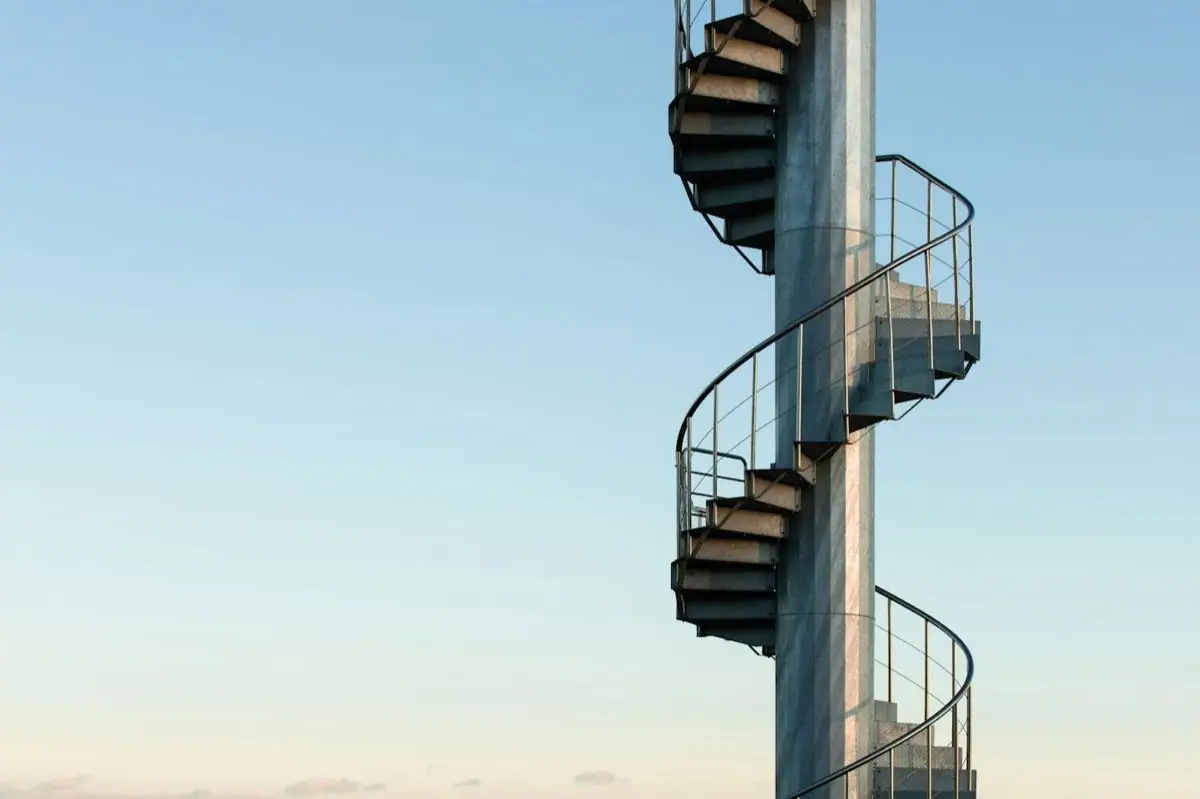
spiral staircasesteel staircasevillarooftopmezzanineUAE
Spiral Staircases in the UAE: Sizes, Design and Steel Fabrication
A spiral staircase saves floor space for roofs, mezzanines and villas. Learn the typical sizes, design rules, finishes and how a steel spiral stair is made and installed.
Al Saqr Al Ahmar Welding and Blacksmith LLC3 min read
When there is no room for a straight staircase, a spiral staircase is often the answer. It fits into a small circle of floor space and gives access to a roof, mezzanine, loft or upper floor. In the UAE, steel spiral stairs are popular for villa rooftops, warehouse mezzanines and plant rooms, and as feature stairs in offices and restaurants. This guide covers sizes, design points, finishes and the fabrication process.
How a spiral staircase works
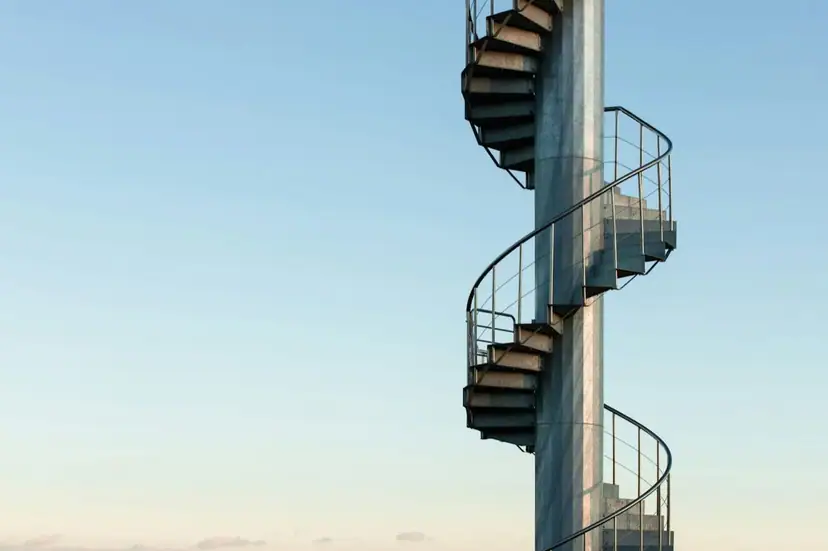
Wedge-shaped treads are fixed to a central steel column and rise around it in a circle. A handrail follows the outer edge, with balusters or infill between treads. Because everything hangs off the central column, the column and its base plate carry most of the load.
Typical sizes
- Diameter: residential spirals are commonly around 1.2 to 2.0 metres across; larger diameters are more comfortable to use and to carry things on.
- Rotation: most stairs turn through 270° to 360° between floors, set by the floor-to-floor height and where you want to arrive.
- Headroom: the stair must leave clear headroom where it passes under the opening above.
Building and fire codes limit where a spiral stair can be used as the only means of escape, so for anything beyond private or occasional access, your consultant decides whether it is allowed. For main escape routes see our guide to external fire escape staircases.
Design points to get right
- Measure exactly: floor-to-floor height decides the number of treads and the rotation.
- Opening size: the hole in the slab or mezzanine must be slightly larger than the stair diameter.
- Entry and exit direction: choose which way you step on at the bottom and step off at the top.
- Handrail and infill: spindles, bars or panels to close the gaps for safety, especially in homes with children.
- Tread surface: chequer plate or grating outdoors for grip; plate with timber or stone finishes indoors.
Finishes for indoor and outdoor stairs
Outdoor spirals on villa roofs or building facades should be hot-dip galvanized, often with a powder-coat colour, to resist UAE heat and humidity. Indoor stairs can be painted or powder coated in any colour, and stainless handrails are a durable upgrade near the coast. See mild steel vs galvanized vs stainless.
From measurement to installation
- Site survey: floor-to-floor height, opening size and entry direction.
- Shop drawings with tread count and rotation for approval.
- CNC cutting of treads and base plate, welding to the central column.
- Coating, then installation, levelling and fixing of handrails.
Spiral stairs are often delivered in sections and assembled on site, which helps when access to a roof or mezzanine is tight.
Frequently asked questions
Is a spiral staircase cheaper than a straight one?
Not always. It uses less floor space, but the curved handrail and individual treads take more fabrication work.
Can furniture be carried up a spiral stair?
Only small items. If you need to move large items, choose a bigger diameter or a straight stair.
Do you also make straight stairs and handrails?
Yes. Read our guide to steel staircases and handrails.
Planning a spiral staircase? Request a quote with the floor-to-floor height, opening size and a photo of the space.
Keep reading
More from the blog
6 November 2026 · 3 min read
Steel Sheds in the UAE: Types, Costs and Permits Explained
Storage sheds, workshop sheds, labour-camp sheds and open canopies: how steel sheds are built in the UAE, what drives the price, and which approvals you need.
5 November 2026 · 3 min read
Car Parking Shade Types in the UAE: Cantilever, Tensile, Pyramid and Steel Roof
Compare the main car parking shade designs used in the UAE, from cantilever and tensile shades to pyramid and steel-roof carports, and pick the right one for a villa or a car park.
3 November 2026 · 3 min read
External Steel Fire Escape Staircases in the UAE: A Practical Guide
Adding or replacing an external fire escape stair? What Civil Defence reviews, design points, materials, and how a steel escape staircase is fabricated and installed.